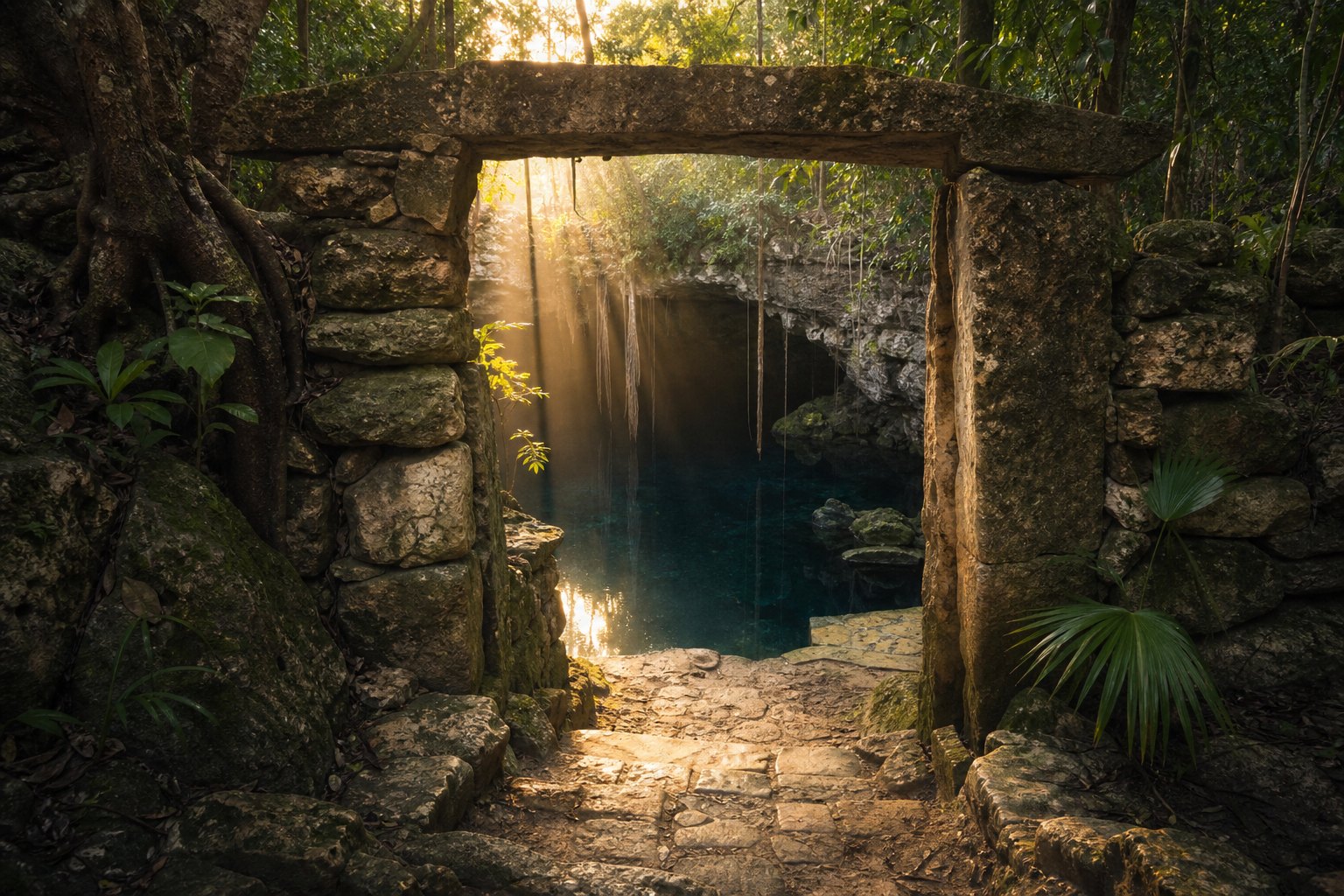
A cenote was never only water
It was sustenance, ceremonial place and part of a community's life. Understanding that relationship means looking at the past without erasing Maya communities in the present.
Change perspectiveConcept image. It does not represent a specific archaeological site.
There is no single story between Maya peoples and cenotes
A cenote could supply water, mark a sacred place, receive offerings or combine several of these roles. Its meaning depended on the site, period and community.
Archaeology, historical records and community memory offer ways into these relationships, but no source turns them into a universal rule. This guide presents layers of interpretation, not a closed definition.
- Place
- Every cenote has its own context
- Time
- Uses and meanings change
- Voice
- Present communities also interpret
From everyday water to sacred landscape
These relationships could coexist. They are not stages of an evolution or categories that apply equally to every place.
- 01
Everyday water
Across much of the Peninsula there are no permanent surface rivers. Access to groundwater shaped settlement locations, water supply and daily life.
- 02
Sacred landscape
Caves and cenotes could connect the earth, the celestial realm and the underworld. They were also associated with origins, rain, fertility and regeneration.
- 03
Ceremonial place
Some cenotes received offerings and became places of pilgrimage or ceremony. Evidence differs from site to site and must be read in context.
- 04
Living territory
Today, Maya communities manage cenotes, pass on knowledge and decide how their territory is visited. The cultural relationship did not end with the pre-Hispanic period.
“Gateway to the underworld” explains one part. It does not tell the whole story.
In Maya worldviews, caves and cenotes could connect different realms. But darkness and depth did not mean death alone: they also evoked origins, rain, fertility and the continuity of life.
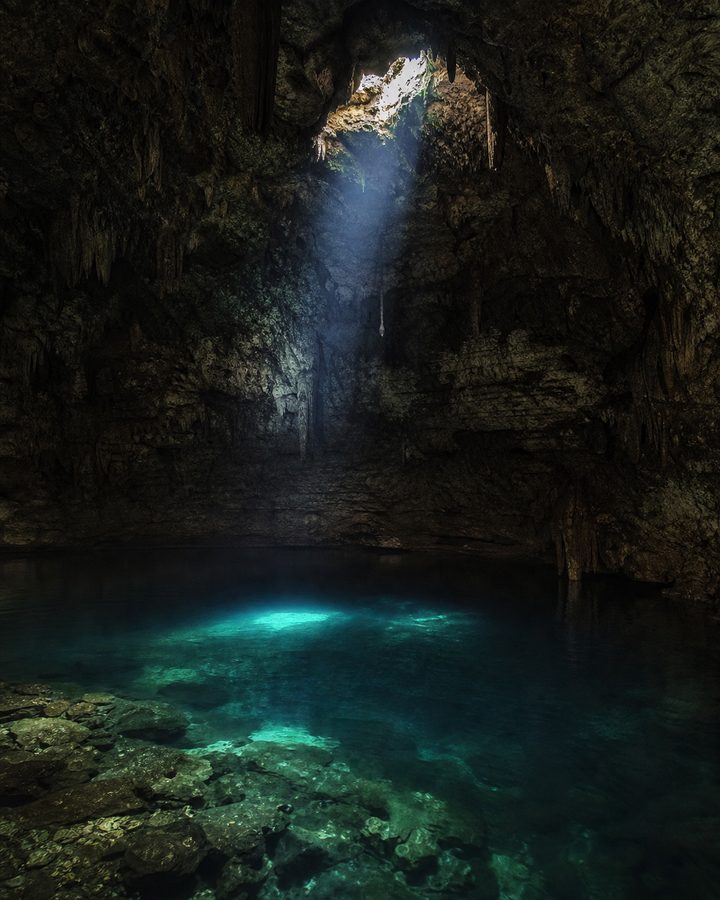
There is evidence of ceremony. Not of one identical practice in every cenote.
Ceramics, tools, ornaments and human or animal remains associated with ceremonial practices have been found at different sites. The Sacred Cenote at Chichén Itzá, for example, was a centre of pilgrimage and offering.
- The find
- Indicates an action that occurred at that place.
- The context
- Helps explain when, how and with what meaning.
- The limit
- Does not support generalising to every cenote.
Heritage does not mean a frozen past
Speaking of Maya culture only in the past erases those who speak Maya languages today, care for and manage cenotes, pass on knowledge and make decisions about their territory.
A community is not part of the cenote’s scenery. It is a contemporary voice with authority over the place.
Practices and meanings change. Recognising this does not weaken history: it prevents distinct peoples from being reduced to one exotic, uniform image.
Respect you can put into practice
You do not need to master the history to behave with care. You do need to recognise that you are entering a place with its own memory and rules.
- 01
Read local rules
Respect closures, restricted areas and guidance from those who manage the site. Not every open space is available to visitors.
- 02
Ask permission
Ask before photographing people, ceremonies, altars or offerings. A visit does not turn community life into a public scene.
- 03
Do not alter evidence
Do not touch or remove ceramics, bones, stone or other objects, even when they appear abandoned. Tell staff if you find something.
- 04
Name with care
Use local names when available and avoid presenting distinct traditions as one uniform culture.
Sources for further reading
Archaeological, cultural and territorial research for going deeper without oversimplifying.